
Therapeutic Plasma Exchange for Alzheimer’s
Therapeutic Plasma Exchange for Alzheimer’s and Dementia:
A Promising Frontier
Could cleaning the blood slow the decline of the mind? A growing body of research says yes.

Alzheimer’s disease remains one of the most devastating diagnoses a person or family can receive. It is the most common cause of dementia, accounting for roughly 70% of all cases worldwide, and the numbers are staggering — an estimated 32 million people currently live with Alzheimer’s dementia, with hundreds of millions more in earlier stages of the disease continuum. For decades, treatment options have been frustratingly limited, focused primarily on managing symptoms rather than addressing underlying causes. But a decades-old medical procedure is generating renewed excitement in the Alzheimer’s research community: Therapeutic Plasma Exchange (TPE).
What Is Therapeutic Plasma Exchange?
Here’s the simplest way to think about it: your blood is made up of cells (red blood cells, white blood cells, platelets) floating in a liquid called plasma. Over time, that plasma accumulates all kinds of things your body doesn’t need — damaged proteins, inflammatory molecules, toxins, and other harmful substances that can affect how your brain and body function.
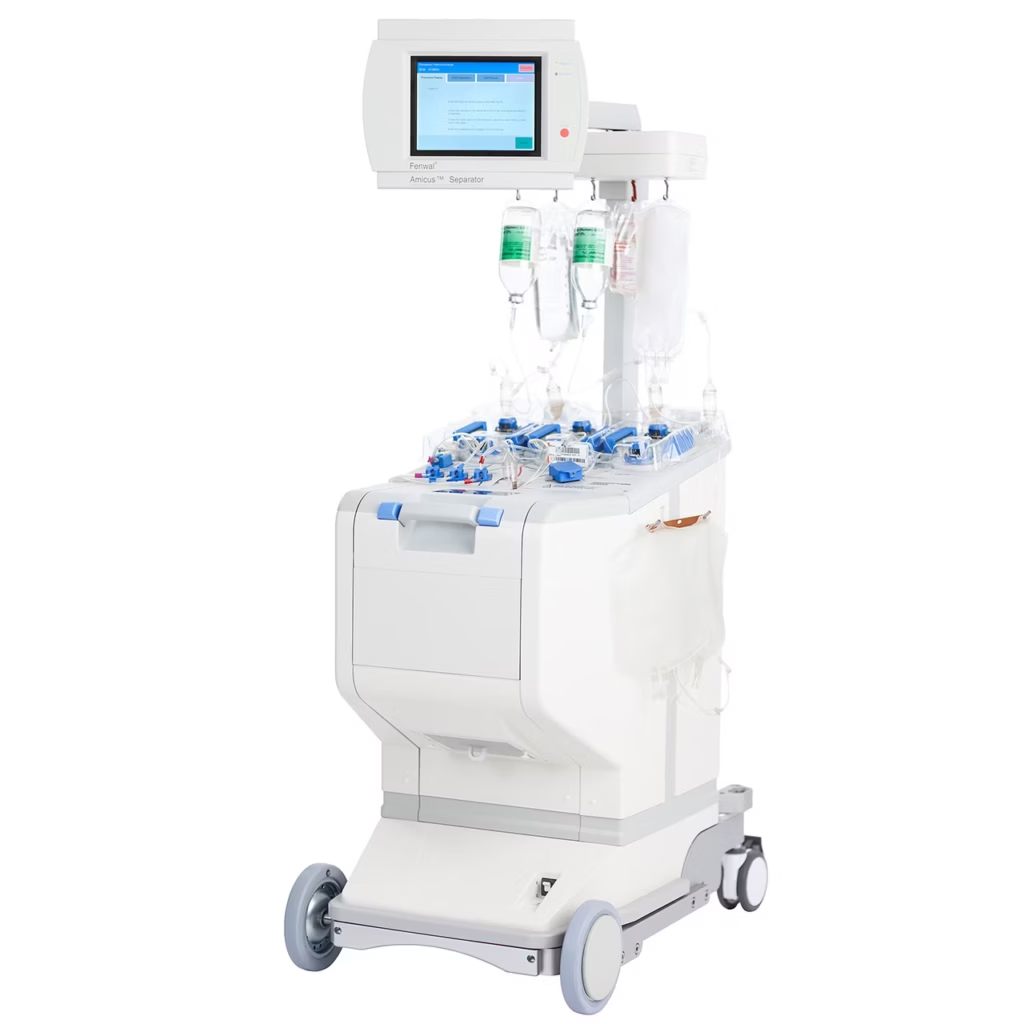
During a TPE session, blood is drawn from the patient, the plasma is separated out and discarded, and a fresh, clean solution — typically made with a protein called albumin — is mixed back in with the blood cells and returned to the body. It’s a bit like changing the oil in your car. You’re not replacing the engine — you’re giving it a cleaner environment to run in.
The procedure itself has been used safely since the 1970s for conditions like Guillain-Barré syndrome and myasthenia gravis. It’s well-understood, and doctors have a lot of experience with it.
Why Therapeutic Plasma Exchange for Alzheimer’s?
One of the things that happens in Alzheimer’s disease is that a sticky protein called amyloid-beta builds up in the brain, forming the plaques that damage neurons and disrupt memory. Scientists have found that amyloid-beta doesn’t just exist in the brain — it’s also present in the blood, and there’s a natural back-and-forth flow between the two.
The idea behind TPE is straightforward: if you remove amyloid-beta from the blood, it may help draw more of it out of the brain, kind of like opening a drain. Less amyloid buildup in the brain could mean slower disease progression.
But that’s not the only way TPE may help. The procedure also clears out inflammatory compounds that contribute to brain damage, and the albumin used as a replacement fluid has its own benefits — it helps transport amyloid out of the body, acts as an antioxidant, and supports healthier immune function.
The AMBAR Trial: Landmark Evidence
This is where it gets exciting. The biggest study on Therapeutic Plasma Exchange for Alzheimer’s is called the AMBAR trial (short for Alzheimer’s Management By Albumin Replacement). It was a rigorous, gold-standard clinical trial — randomized, double-blind, and placebo-controlled — conducted at 41 medical centers across the United States and Spain with 347 patients.
Here’s what the researchers found after 14 months of treatment:
- Daily functioning declined 52% less in treated patients compared to the placebo group. That means activities like dressing, cooking, and managing finances were preserved significantly longer.
- Cognitive decline was reduced by 66% on a standard Alzheimer’s assessment scale.
- Overall disease progression slowed by 71% on another widely used measure.
- For patients with moderate-stage Alzheimer’s specifically, the results were even more dramatic — 61% less progression across the board.
- And here’s something that really matters: there was zero risk of brain swelling or bleeding (a side effect called ARIA that can occur with some of the newer Alzheimer’s antibody drugs).
Brain scans from the study also showed that treated patients had better preservation of brain structures important for memory, like the hippocampus.ural and functional findings, including better preservation of hippocampal volume and improved brain perfusion in treated patients.
Real-World Confirmation
Clinical trials are essential, but the true test of any therapy is how it performs in everyday clinical practice. In 2025, an independent research team in Argentina published the results of a real-world study comparing 32 patients who received Therapeutic Plasma Exchange for Alzheimer’s to 194 historical controls from the same memory clinic.
Using a protocol modeled on AMBAR — six intensive weekly sessions followed by monthly maintenance sessions — and a completely independent patient population, the results were consistent with the original trial findings:
- TPE-treated patients showed 45% less decline on the Mini-Mental State Examination compared to controls.
- Memory deterioration was reduced by 88% for immediate recall and 74% for delayed recall.
- Benefits extended across multiple cognitive domains, including language and executive function.
- Of 514 total procedures performed, more than 81% were uneventful, and no severe adverse events were reported.
These findings provide important validation that the benefits of TPE observed in the controlled AMBAR trial can be replicated in routine clinical settings.
How Does TPE Compare to Other Treatments?
You may have heard about newer drugs — monoclonal antibodies — that target amyloid in the brain. These represent real progress, but they come with a significant downside: a notable percentage of patients experience brain swelling or small bleeds as a side effect, which requires careful monitoring with repeated brain scans.
TPE takes a different approach. Instead of introducing a new drug into the body, it works by removing harmful substances from the blood. Its safety profile has been established over decades of use, and the AMBAR trial confirmed that this track record holds true for Alzheimer’s patients as well.
That said, these aren’t necessarily either/or options. As research evolves, TPE could potentially become part of a broader treatment strategy that combines multiple approaches.
A Few Things to Keep in Mind
As promising as this research is, it’s important to go in with realistic expectations:
Cost is a factor. Treatment involves multiple sessions over many months, and coverage can vary. It’s worth having a candid conversation with your healthcare provider about what to expect financially.
Timing matters. The studies focused on patients with mild-to-moderate Alzheimer’s. If the disease has already progressed to a severe stage, the window for meaningful benefit may have passed. This is one of the strongest arguments for exploring treatment options early.
It’s not a cure. TPE appears to significantly slow the rate of decline, but it doesn’t stop or reverse Alzheimer’s disease. Think of it as buying more quality time — which, for many families, is incredibly valuable.
More research is underway. While the evidence is encouraging, the scientific community agrees that larger follow-up studies are needed to nail down the best treatment protocols and long-term outcomes.
Availability can be a challenge. TPE requires specialized equipment and trained medical staff, so it’s not offered everywhere. You may need to seek out clinics that specialize in apheresis procedures.
The Takeaway: Reason for Hope
For families facing this diagnosis, Therapeutic Plasma Exchange for Alzheimer’s represents something increasingly rare in the dementia landscape — a treatment approach with a plausible biological rationale, meaningful clinical trial evidence, independent real-world confirmation, and a favorable safety profile. It doesn’t cure Alzheimer’s. No current treatment does. But the evidence suggests it may meaningfully slow the rate of cognitive and functional decline, particularly when started in the earlier stages of the disease.
As research continues and awareness grows, TPE may well become an important component of a multi-faceted approach to Alzheimer’s care — one that goes beyond symptom management to address the underlying biology of the disease.
